Craig's Native Grass Juicy Gossip & Research

No. 14- September 2003, with the latest update October 2007

Reducing Global Warming with Revegetation,
with special attention to the Arabian Peninsula, and an environmental-friendly method to significantly increase water resources of the area.

Edited, published and Copyright © 2001, 2002, 2003, 2006, 2007 by Craig Dremann, The Reveg Edge (sm). P.O. Box 609, Redwood City, Cal. 94064. Phone (650) 325-7333 or email. The URL of this issue is: http://www.ecoseeds.com/juicy.gossip.fourteen.html or http://www.ecoseeds.com/Saudi.html

Portions of this article were originally published as "How Revegetation Can Reduce Global Warming" in the Planet Drum Pulse (2002) Winter, pages 1-2. Planet Drum Foundation, San Francisco, CA., and translated into Portuguese "O Plantio de Vegetação pode Reduzir o Aquecimento Global" The Ecologist Brasil (2002) Inverno 5: 38.

Desert Stipa grass photos Copyright © 2002 by Craig Dremann.

If you would like to read the previous and more recent issues:
Index at http://www.ecoseeds.com/juicy.html


Reducing Global Warming with Revegetation with special attention to the Arabian Peninsula, and an environmental-friendly method to significantly increase water resources of the area. By Craig Dremann
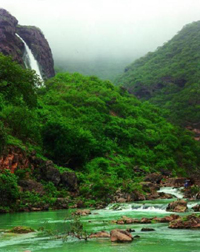
The world's attention has recently been focused on the politics and geologic resources of a strip of desert land from the Arabian peninsula eastward to Western India. What about the health of the ecosystems of that region? Could the health of the native perennial grasslands, of that region in particular, have planetary implications for the rest of us?

This is the story of the humble perennial grass plants, that formed a savanna over these desert areas, until 5,000 to 6,000 years ago. Pollen records and dust records from the Arabian peninsula (Van Campo et al, 1982; Sirocko et al, 1993) and most recently, ice cores from Kilimanjaro (Thompson et al, 2002) record an abrupt change from wet to dry.

Humans in this area went from a Neolithic hunter-gather life, about 5,500 years ago, to settling in city-states, with agriculture and widespread grazing of domesticated cattle, sheep and goats. The cattle ate the perennial grasses and the goats and sheep ate everything else. By 4,700 years ago, everything from Morocco to Western India was converted from perennial grasslands, to desert.

There is a statue that records this vegetation change, one copy in the University of Philadelphia and the other in the British Museum: "Ram in the Thicket". Made in Ur, Mesopotamia (modern Iraq) 4,700 years ago, it shows a ram reaching high into a thicket to eat some leaves. This statue may be one of the only examples of human-induced environmental change incorporated into art.

"Ram in the Thicket" located at the University of Philadelphia, made in Ur, Mesopotamia 4,700 years ago, it shows a ram reaching high into a thicket to eat some leaves. (Photo from http://www.museum.upenn.edu/new/exhibits/galleries/ram/ramconservation5.shtml)

This statue shows an environment, where all the ground-level forage has been stripped off the land for many years, all the palatable shrubs are gone, only leaving thorn bushes, with even their lower branches have been stripped bare. Archeologists are not sure what the ram statues signify, but they suspect it was something religious. Perhaps it could have been a prophesy: "When the ram reaches high to eat the leaves of the thorn bushes, your civilization will be destroyed"? The rams did eat the thorn bush leaves, and Ur was destroyed.

The stripping of the vegetation and subsequent desertification forced the hunter-gathering lifestyle to be completely abandoned in Arabia by 5200-5600 years ago (Thompson et al, 2002). The largest bare areas today are the 300,000 square miles of the southern portion of the Arabian peninsula is called Rub Al Khali or "The Empty Quarter", and everyone has heard of the Sahara desert. Plus a new bare portion has been forming from recent droughts, that stretches from Western India through Afghanistan.

Looking at photographs of the first civilizations of this area: there is nothing there at these ancient sites today, just ruins, rocks and sand to the horizon, no humans or even a speck of green vegetation of any sort. Look at photos of Ur in Iraq, Palmyra in Syria, or Pasargadae in Iran. All this bare ground causes dust storms, which an estimated 260 million tons is blown annually into the Atlantic ocean from the Sahara alone (Van Campo, 1982).

On a global scale, all that bare ground getting hot by the sun, is blocking the world's precipitation cycle. The five thousand years of grazing of North Africa and the Middle East has left about five billion acres mostly bare of any vegetation--that constitutes about 15% of the planet's land area, if you exclude Antarctica and Greenland.

The world's clouds mostly start out as moisture coming off the Antarctic ice sheet. They circle eastward hugging the Antarctic coast, until they get just east of Australia, when they move north to the equator, then westward along the equator to China. At China and Japan, a portion breaks north that eventually ends up along the coast of Alaska and then moves southeastward to rain on California in the winter, but the major portion keeps traveling westward and creates the monsoons in India in the summer of the northern hemisphere.

What happens when the sun hits the bare soils of the strip from Western India to the Arabian peninsula, is that there is no longer any perennial grasses to insulate the rocks and soil from absorbing the heat of the sun. If the shade temperature at noon is 90°F, the top inch of bare soil can be 126°F versus only 88°F when only one small perennial native grass plant growing. The Mojave's Desert Stipa of the Californian desert (Achnantherum speciosum), shows nearly a 40 degree difference, below.


Above: "Six miles south of Palmdale, on September 27, 2000 at noon a California native Harvester ant finds the coolest Mojave soil temperature underneath the perennial native Desert Stipa grass plant" Copyright © 2000 by Craig C. Dremann. Temperatures are in Fahrenheit ± one degree, measured 0.25" (6 mm) below the soil's surface. Grid is in inches. The plant's diameter is nine inches by eight inches, and the cooling effect of the plant includes the dense shade cast upon the desert's surface.

The bare rocks and soil absorb the sun's heat, which in turn heats the air, which in turn creates an area of with a very low dew point. When the heat of the sun is absorbed by the exposed rocks and sand, the heat is carried a long way underground, like heating a skillet on the stove. When water moisture in the air, that could produce rain, does move towards these hotter, bare areas, the rain cannot precipitate out of the air, when the dew point is too far from the air temperature.


Above: The University of Wisconsin's web site at http://www.ssec.wisc.edu/data/comp/latest_cmoll.gif shows land and ocean temperatures, and you can see the blockage of the rainfall by the denuded Middle-Eastern countries.

The global moisture conveyor-belt stopped in western India, Afghanistan and the Arabian peninsula during most of the summers of this decade , causing floods in Southeast Asia and central India when the moisture is blocked by the hot soil surface temperatures.

If an annual investment could be made, to revegetate large area of the Middle East, with their own local perennial native grasses and savanna-tree (like the native Acacias), the global moisture conveyor belt would continue across the Equator, through Africa, to bring rain to the Middle East and eventually, the farms in the Midwest and Southwest United States.

FOCUS on the Arabia Peninsula


The Arabian peninsula's pivotal location, could become the "stepping stone" to allow the monsoon moisture to move westward each summer, if the perennial native grasses and savanna shade-trees were replanted. Left: Shows the line where the western movement of the monsoon moisture is blocked, May to September each year. Right: Producing cooler soil temperatures in summer with revegetation of the bare soils, could help the monsoon moisture to rain over the Arabian peninsula, as it did regularly 2,000-6,000 years ago.

SALALAH, OMAN as the example. The cool-soil conditions created by perennial vegetation, that produce rainfall from the summer monsoonal moisture, still occurs in the mountains north of the city of Salalah Oman.


THE ANCIENT TRACK of moisture across the Arabian peninsula does not show up as clouds, but water vapor, still following the 6,000 year old rain-path, only it is now extremely suppressed by the hot, bare soils. Hot bare soil, raise the dew point, stopping the water vapor from creating rainfall. Water vapor from http://www.ssec.wisc.edu/data/comp/wv/LATEST_WV.gif

HOT BARE SOILS of the Arabian peninsula has such a strong effect to block moisture, that the category-5 tropical cyclone Gonu couldn't make landfall in June, 2007, and was bottled up in the Gulf of Oman for several days instead of moving inland.


EVEN AT CATEGORY-5 strength, Tropical Cyclone Gonu at over 155 mph, was not strong enough to break through the hot bare-soil barrier of the Arabian peninsula in June 2007 (NASA, Earth Observatory).

Tropical Cyclone Gonu, bottled up like a cork in the Gulf of Oman, instead of producing useful rain across the Arabian peninsula's Empty Quarter, was repelled for days by the hot bare-soil temperatures. (NOAA)

Monsoon moisture and vegetation, with clouds forming over vegetated areas and no clouds forming over the hot-bare soil. Image June 30, 2007 http://cimss.ssec.wisc.edu/tropic/real-time/indian/images/xxirmet5bbm.jpg

If large areas of the Arabian peninsula could be revegetated with the local native grasses and the savannah shade-trees, that area is in a pivotal location between Africa and India, and cooler soil temperatures in the summer might be enough to provide the "stepping stone" necessary for the summer monsoon moisture to continue falling in a westward path.

The Arabia Peninsula Ecological Restoration Preserve? What if most of the land on the Arabian peninsula below the Tropic of Cancer, grazing was eliminated for ten years as an experiment, and the land was rested, to allow the land to revegetate naturally? And furthermore, what if a significant investment was made to speed up the natural restoration process, by harvesting and planting local native perennial grass seeds?

The Arabian peninsula current receives only four inches (10 cm) or rainfall per year, but relic plant species in the area's flora, indicate that raising the annual rainfall to at least ten inches (25 cm) could be a reasonable goal, and perhaps as much as a total of 25 inches (50 cm) could be achieved. This increased summer moisture could start rivers flowing again that haven't flowed for 2,000-6,000 years, and would help lower the annual summer maximum daytime and night time temperatures for the country by as much as 10-20 degrees F.

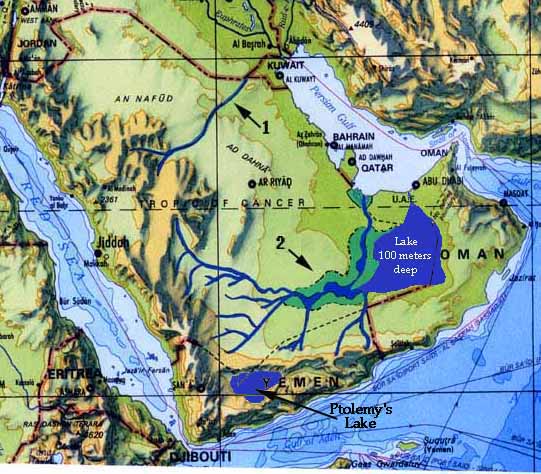
RIVERS IN ARABIA? See where two major rivers existed in the past, below:


Two major Arabian peninsula rivers that could start flowing again.

River #1
was 650 miles long, and averaged 5 miles wide and 50 feet deep along its entire length, was studied by Boston University scientist Farouk El-Baz in 1993. (DISCOVER, July 1993 "A river in the desert").

River #2, the Empty Quarter river and its associated lakes and marshlands, flowing through the southern Arabian peninsula, extrapolated from five sources:

(1.) A NASA Landsat composite of Saudi Arabia made by geology.com posted at http://geology.com/world/saudi-arabia-satellite-image.shtml , (2.) An article about Aramco geologist Hal McClure's thesis, in a 1989 issue of Aramco World, "Lakes of the Rub' al-Khali" http://www.saudiaramcoworld.com/issue/198903/lakes.of.the.rub.al-khali.htm
and
(3.) Ancient riverbed locations from Dr. Abdallah E. Dabbagh (et al) at King Fahd University in Dhahran, "Geologic and Hydrologic Studies of Saudi Arabia Under the Spaceborne Imaging Radar-C (SIR-C) Science Plan" http://southport.jpl.nasa.gov/ProgressReports0496/Dabbagh.Final.html
especially the "Figure 11 - Pleistocene drainage of Arabian Peninsula." http://southport.jpl.nasa.gov/ProgressReports0496/gifs/dabbagh11.gif, (4.) Philby, H. St. John B. 1933 book "The Empty Quarter: Being a description of the Great South Desert of Arabia known as Rub' al Khali" (pub. Henry Holt & Co. NY) on his chapter "Forgotten Rivers" and finding river beds with fresh-water shells, and (5.) Google Earth.

Basemap
is from "The World" 1998 scale 1:30,000,000 at the equator, published by the Dept. of Defense, National Imagery and Mapping Agency
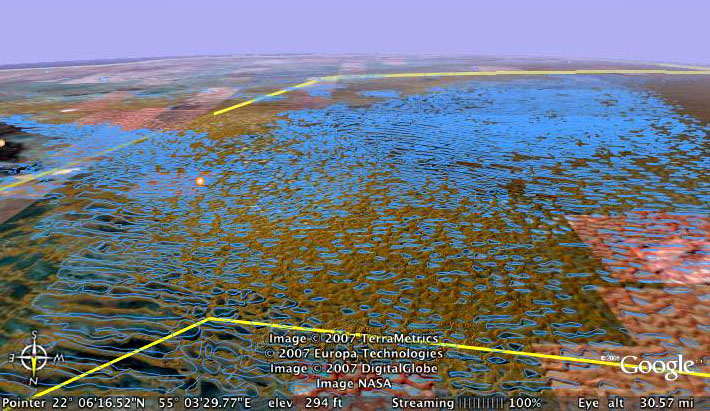

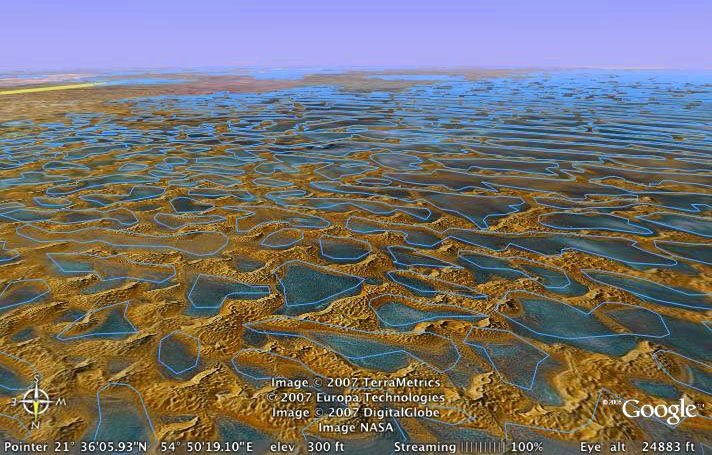
The Empty Quarter's lake beds, according to McClure, are distributed down the middle length of the Rub' al-Khali" - a distance of some 750 miles (1,200 kilometers) and bones of hippopotamus, water buffalo and long-horned cattle, wild asses, wild goats or sheep, oryx, gazelle, and possibly camels and hartebeest, as well as fresh water clam shells, have been found in the ancient lake mud.

Written records exist, describing rivers in Arabia flowing in historic times. In 430 BCE, Herodotus in "The Histories" Book III mentions a "great river in Arabia, called the Corys". Later, the historian Strabo in 22 CE in "Geography" Book XVI tells about the Roman expedition in Arabia of Aelius Gallus arriving at a river in the middle of the desert, and describes the southwestern part of Arabia with enough rain in the summer to produce two crops a year, and reports that rivers were flowed into lakes.


.The Empty Quarter's huge river bed and falls, showing massive waterflows in the middle of the Empty Quarter at 18 deg.08'24.10"N, 45 deg.25'05.88"E, on Google Earth.

------------------------------------------------------------------------------------------

The former perennial grassland areas of the Kingdom of Saudi Arabia, called "desert rangelands" cover about 76% of the country, or 419 million acres (1.7 million square km.) (AbuZinada, 2002), and there are rangelands in the adjoining countries, like the Sultanate of Oman.

A portion of the 419 million acres of the desert rangelands, could be an ideal location for the world's largest Ecological Restoration Preserve, a project to reduce global warming, and to help increase the annual rainfall and increase the water supply of Arabia. Perhaps this would be the best spot on the planet to start the conversion of the desert--which is currently mostly dwarf-shrub steppes and annual grasses--back to its original perennial native grasslands, and get the desert rivers flowing again?


ARABIAN native perennial grasslands, photographed in 1962. (Photo by H. Heady)

The native grasslands of the Arabia were studied by Professor Harold F. Heady, a grasslands expert from the University of California at Berkeley, as a consultant for the UN Food and Agriculture Organization in 1962. Traveling over 3,500 miles (5,758 kilometers) by automobile, he found remnants of the Arabia's original perennial grasslands, like the Panicum turgidum shown above.

Desert native grasslands seen by Dr. Heady, were located "on the plains of the Red Sea south of Jeddah, where the soil is so covered with vegetation that it disappears from view at a distance of 10 to 15 meters from the observer." Also, a 50-kilometer-wide [30-mile-wide] area of Panicum turgidum near Hadriyah along the Tapine road was in excellent condition, as were similar stands near Al Lith', south of Jeddah. (Heady, 1972)


WHERE IS ALL THIS ATMOSPHERIC HEAT COMING FROM? It is generally known that carbon dioxide and other greenhouse gases trap heat in the atmosphere, but how did the heat get there in the first place? Heat is reflecting off bare soil in hot, arid areas.

Above: Outgoing radiation http://www.cdc.noaa.gov/map/images/olr/olr.seasonal.gif and there is an animated website at http://www.cdc.noaa.gov/map/images/fnl/olr_90.fnl.anim.html

THE HOT-ARID AREAS OF THE WORLD are major contributors of heat towards global warming of the planet, whether they are in Afghanistan, the Arabian peninsula, or the Mojave and Sonoran "desert" areas of the United States. These bare arid areas, which were formerly perennial grasslands, are unfortunately also act as the valves in the world's precipitation cycle.

Restoration of these areas could be the easiest and fastest-acting action to help mitigate global warming, and aid in continuing the flow of a global rainfall cycle that the northern hemisphere crop lands depend on.

DEW POINT? What is dew point? It is the air temperature when water precipitates out, either as rain, snow or as dew.

What happens when the night-time dew point temperatures rising even a few degrees? There's been much talk about the global maximum temperatures rising, due to global warming. However, if nighttime temperatures raise even a few degrees above the dew point, then precipitation doesn't fall, and that is probably what is keeping the monsoon rain from falling in the summer in the Middle East and North Africa.

THREE SIMPLE EFFORTS could help bring the dew point closer to the air temperature:

(1.) Planting the cities of the Arabian peninsula with native shade trees, like the native Acacia, (2.) Eliminating any grazing of rangelands within a 50 mile radius around the cities, and,
(3.) Densely replanting local native perennial grasses to shade the bare soils in the summer.

When the dew point is within a few degrees of your air temperature, then you get precipitation.
The already existing low pressure area sitting over the Middle East from spring to fall, combined with a change in the dew point, you have the potential of a whole lot of rainfall. By making an investment in modifying the ecological conditions of the land with revegetation, you could change the dew point, so precipitation could start to occur, after a 2,000-6,000 year absence.

NATIVE PERENNIAL GRASSES> INSULATE the soil in the daytime from the sun's heat> LESS solar heat is absorbed> LOWER daytime and night time air temperatures> DEW POINT gets close to air temperature = PRECIPITATION.


The Sahara's and Arabian peninsula's heat, moving northward into Europe and eastward, August 2003, killing an estimated 35,000 Europeans.

Summer, 2007, this same weather pattern appears to be developing again--the heat-island blocking the summer monsoon's movement, stalling it and causing floods in India. Also, the heat-island effect in southern Europe causing drought and forest fires, and pushing the storms from the Atlantic north and squarely into the UK, causing floods.


Contact: Craig C. Dremann, Director of The Reveg Edge, Box 609, Redwood City, Ca 94064 USA (650) 325-7333, Web = http://www.ecoseeds.com/greatbasin.html to see photos of an arid grassland restored. Developing native grassland restoration technologies for 35 years.


Literature cited:

AbuZinada, Prof. Dr. Abdulaziz H. 2002. First Saudi Arabian National Report on the Convention on Biological Diversity. Pub. The National Commission for Wildlife Conservation and Development. PDF file, http://www.biodiv.org/doc/world/sa/sa-nr-01-en.pdf

BASE MAP:
The World" 1998 scale 1:30,000,000 at the equator, published by the Dept. of Defense, National Imagery and Mapping Agency. Distributed by the US Geological Survey.

Clark, Arthur. 1989."Lakes of the Rub' al-Khali" Aramco World. http://www.saudiaramcoworld.com/issue/198903/lakes.of.the.rub.al-khali.htm

DISCOVER, July 1993 article "A river in the desert - Remote sensing photo locate ancient river in Arabian peninsula".

Heady, Harold F. 1972. "Ecological Consequences of Bedouin Settlement in Saudi Arabia" in The Careless Technology: Ecology and International Development, edited by M. Taghi and John P. Milton, pages 683-693. Natural History Press, New York. Online at http://uicn.org/themes/ceesp/Publications/SL/CT/Chapter%2036%20-%20The%20Careless%20Technology.pdf

Philby, H. St. John B. 1933. The Empty Quarter: Being a description of the Great South Desert of Arabia known as Rub' al Khali. Henry Holt & Co., NY 432 pages. Call No. DS247 R8 P5

Sirocko, F. et al. 1993. Century-scale events in monsoon climate over the past 24,000 years. NATURE 364: 322

Thompson, Lonnie G. et al. 2002. Kilimanjaro Ice Core Records: Evidence of Holocene Climate Change in Tropical Africa. SCIENCE. 298: 589-593.

Van Campo, E. et al. 1982. Climatic conditions deducted from a 150-kyr oxygen isotope-pollen record from the Arabian Sea. NATURE March 4, 1982, 296: 56-59.

Website: http://southport.jpl.nasa.gov/ProgressReports0496/Dabbagh.Final.html Dabbagh, Abdallah E. et al. 1996. "Geologic and Hydrologic Studies of Saudi Arabia Under the Spaceborne Imaging Radar-C (SIR-C) Science Plan."

Website: http://southport.jpl.nasa.gov/ProgressReports0496/gifs/dabbagh11.gif "Figure 11 - Pleistocene drainage of Arabian Peninsula."

Website: http://www.museum.upenn.edu/new/exhibits/galleries/ram/ramconservation5.shtml
--Photo of "Ram in Thicket", Museum of the University of Pennsylvania, the story of its conservation.

Website: http://www.drought.unl.edu/dm/monitor.html shows the drought impact on the United States when the global summer precipitation has been blocked upstream.

Website: http://www.ssec.wisc.edu/data/comp/latest_cmoll.gif , Univ. of Wisconsin's Land & Oceans Temps.

Website: http://cimss.ssec.wisc.edu/tropic/real-time/indian/images/xxirmet5bbm.jpg , Univeristy of Wisonsin's Indian Ocean satellite view of monsoon moisture.

Website: http://www.ssec.wisc.edu/data/comp/wv/LATEST_WV.gif , University of Wisconsin's World Water Vapor

Website: http://geology.com/world/saudi-arabia-satellite-image.shtml , composite of NASA Landsat images of Saudi Arabia.

Website: http://www.cdc.noaa.gov/map/images/olr/olr.seasonal.gif - Outgoing radiation.

Website: http://www.cdc.noaa.gov/map/images/fnl/olr_90.fnl.anim.html - Outgoing radiation movie.

Website: http://eob.gsfc.nasa.gov/Newsroom/NewImages/images.php3?img_id=4900 - NASA Earth Observatory, "Central Sarah: A Wet Past"

Website: http://science.nasa.gov/headlines/y2001/ast05jan_1.htm - Case of the Missing Mars water.


Another Related Web page of Interest:

Website: http://www.iucn.org/themes/wani/eatlas/html/gm10.html - "[Map] 10 - Dryland Area by Basin Watersheds of the World : Global Maps"---IUCN -The World Conservation Union.---"Drylands, because of their extensive area, can store large amounts of carbon, most of it in the soil rather than in vegetation. Improving the carbon storage capacity of drylands may be one method to help offset global warming by lowering CO2 concentrations in the atmosphere."


Updated October 11, 2007