Great Basin Native
Ecosystem Restoration
The Reveg Edge, consulting services,
inventing licensed ecological restoration technologies - Box 361
Redwood City, CA 94064 - Phone (650) 325-7333
Craig Carlton Dremann, owner.
Photos and text copyright
© 1997, 2001, 2010, 2017 and 2020 by Craig C.Dremann
The 1993-1995 planting for the
100-mile gas pipeline from Alturas to Susanville through BLM lands.
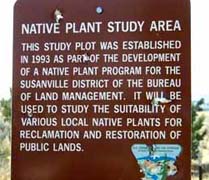
Original test plot site in Lassen County, at US 395 Post Mile
100.00 and junction of Ram Horn Spring Road, is permanently preserved
as a Native Plant Study Area.
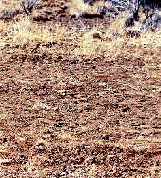
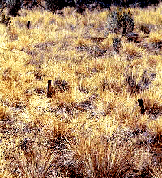
Choose between failure and success. Cheatgrass,
left, or solid local natives with no weeds, on right.
Successful Great
Basin Native Grassland restoration relies a few basic concepts:
1. Plant very small scale
test plots, with LOCAL
GENETIC material.
2. NEVER use seed MIXES, or native CULTIVARS, or non-local
seed.
3. Use VERY SMALL test plot sizes and try many different local species and varied
treatments. The size for each treatment for this project, was
3 feet by 6 feet. If your methods do not work on 18 square feet,
it is not going to work on 18,000 acres or 180,000 acres like
some of the Nevada, Idaho and Oregon cheatgrass fires are producing.
4. Keep planting, until you achieve SUCCESSFUL small scale
test plots for each species.
5. Check for the GRANIVORE-desires for every native seeds
you want to plant, both ants and rodents, and invent methods to
stop robbing and caching the seeds.
6. Learn to use the ALLELOCHEMICAL effects of the native
plants, and you will be able to produce successes every time,
with allelochemicals suppressing the weed seeds from ever sprouting.
7. Expand successes over larger areas, ONLY after you have
produced successful techniques in your test plots.
6. Plan your BUDGET for the larger area, to be able to have
the ecotype seeds collected locally by professional collectors,
and contract for commercial bulk reproduction of those locally
collected seeds.
Performance standards
for local Great Basin native grasses,
within two years from sowing,
should produce the following plant diameters:
Blue bunch wheatgrass = 3", Great
Basin wild rye = 5", Indian Ricegrass = 3-5", Poa =
2", Sitanion = 6" and Thurber's Stipa = 4".
Within one year or less, you need as close to 100% native
cover. If not, start your test plots over.
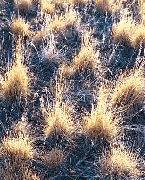
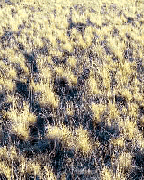
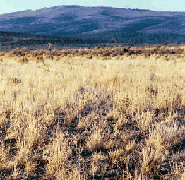
Photos below, the restored
pipeline route with Bluebunch Wheatgrass,
cheatgrass-free, five years after sowing.
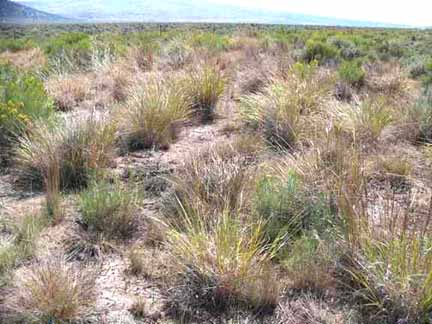
25 YEARS LATER, original
test plot site is a "Native Plant Study" area, located
in Lassen County along US 395 PM 100.00, off Ram Horn Springs
Road. Photo below, the restored pipeline route.
EXAMPLE of what you NEVER want to see happen in any of your test
plots:
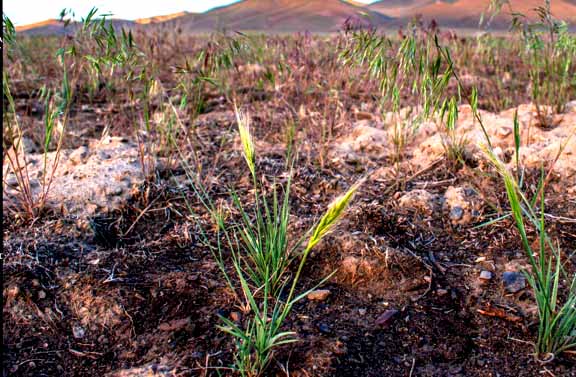
US government-sponsored 2019
native seed sowing in a study plot. Results
one year after sowing natives for the Rebel Creek fire, a single
native squirreltail plant sprouted, surrounded by an ocean of
cheatgrass seedlings? Proper seeding methods used anywhere
in the Great Basin, should be able to produce solid natives with
very close to zero cheatgrass within six months. Photo from the
USFWS June 2020 report "Using local seeds to save the sage"
by Joanna Gilkeson. Photo by Sarah Kulpa, USFWS.
The Reveg Edge, Box 361,
Redwood City, CA 94064 (650) 325-7333 -
Craig Carlton Dremann
- email
Updated December 20, 2022 - Go to The
Reveg Edge website